Note: This is not Mortgage Equity Withdrawal (MEW) data from the Fed. The last MEW data from Fed economist Dr. Kennedy was for Q4 2008.The following data is calculated from the Fed's Flow of Funds data and the BEA supplement data on single family structure investment. This is an aggregate number, and is a combination of homeowners extracting equity - hence the name "MEW", but there is little MEW right now - and normal principal payments and debt cancellation.
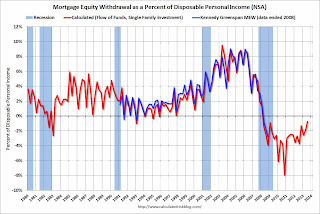
For Q3 2013, the Net Equity Extraction was
minus $24 billion, or a negative 0.8% of Disposable Personal Income (DPI). This is the smallest negative equity extraction since Q1 2008.
 Click on graph for larger image.
This graph shows the net equity extraction, or mortgage equity withdrawal (MEW), results, using the Flow of Funds (and BEA data) compared to the Kennedy-Greenspan method.
There are smaller seasonal swings right now, perhaps because there is a little actual MEW (this is heavily impacted by debt cancellation right now).
The Fed's
Flow of Funds report showed that the amount of mortgage debt outstanding increased by $10.0 billion in Q3. This was the first increase in mortgage debt since Q1 2008. Since some mortgage debt is related to new home purchases, net negative equity extraction was still slightly negative in Q3.
The Flow of Funds report also showed that Mortgage debt has declined by over $1.3 trillion since the peak. This decline is mostly because of debt cancellation per foreclosures and short sales, and some from modifications. There has also been some reduction in mortgage debt as homeowners paid down their mortgages so they could refinance. With residential investment increasing, and a slower rate of debt cancellation, it is possible that MEW will turn positive again soon.
For reference:
Dr. James Kennedy also has a simple method for calculating equity extraction: "
A Simple Method for Estimating Gross Equity Extracted from Housing Wealth". Here is a companion
spread sheet (the above uses my simple method).
For those interested in the last Kennedy data included in the graph, the spreadsheet from the Fed is
available here.

 Click on graph for larger image.
 Retail sales ex-gasoline increased by 5.5% on a YoY basis (4.7% for all retail sales).
 Click on graph for larger image.
 Click on graph for larger image.
 Click on graph for larger image.